Film Interpretation

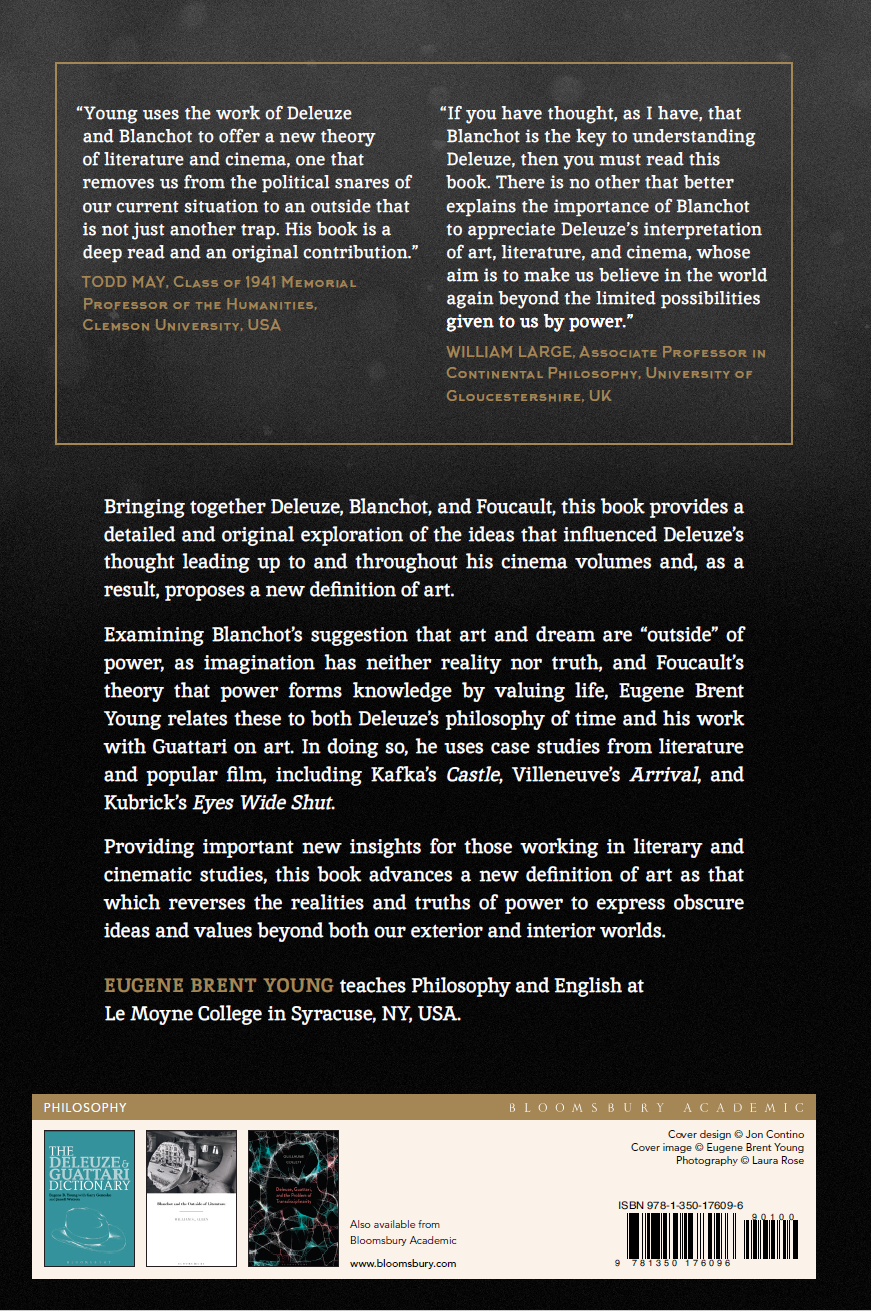
This site will expand on the approach to cinematic art in my new book (pictured here) with video essays explaining the films of Stanley Kubrick, Denis Villeneuve, and others.
(click on book images to enlarge)
Click here to check out my video essay on ENEMY (Denis Villeneuve, 2013)!
More to Come Soon!
One of the most satisfying cultural experiences is perhaps to view a moving and thought-provoking film and then to encounter an equally thought-provoking interpretation of it. It is a cliché that art transforms how we perceive, feel, and think—and interpretation is also, for many of us, a key component that solidifies such a transformation. But what films we choose to interpret as “art” is a contentious question for a medium that seems to be “mass produced,” an empty projection of ghostly images. … (Preface)
If fiction truly has a “relation” to this world, it is one best characterized as ignorant, unconcerned, and indifferent. Why? Because fiction has no rules, no laws, no reality, and no truth: how on earth can we assume it therefore has some role in our world of law and of truth? Does this not forever tie it to a judgment that is, if not dogmatic and unreflective, then at the very least grounded in some assumption that is forever foreign to the work of fiction? And even if fiction can be judged on its own terms, how can it be apart from an empty formalism, which would offer a detached or “formulaic” analysis of its internal relations and craft?
The answer to these questions is that it is not art that is the object of judgment, it is our own judgments that are the object of art: if art can reverse the effects of power, it is by seizing us or drawing us in precisely by virtue of our judgments and knowledge, our perceptions and affections oriented toward life. … Just as power, then, produces truth and reality, as well as our normative judgments, of which we can be critical, so too do most films and fictional works. But fiction can, artistically, make reality impossible to discern and truth impossible to discover. … Drawn in precisely by our judgments, we are immersed in an experience that cannot be explained as true or discerned as real … We thus “escape” or withdraw from the world into the imaginary, but, like the dream, we cannot escape the imaginary once it … fascinates and touches us. …
To interpret works of art, in these terms, is to conceive their relations without “capturing” their material in the form of judgment…—but, impassioned, it also expresses the value inherent to a sensibility reshaped by this withdrawal beyond reality and truth. As Deleuze states in an oft-cited remark, “what has value can be made or distinguished only by defying judgment. What expert judgment, in art, could ever bear on the work to come?” In other words, it is the defiance of normative judgment by the work of art that makes it worthy of interpretation in the first place; if art is actually expressing the new and different (rather than values tied to life), then it could never be anticipated by “expert judgment.”
The role of criticism, in this context, finally diverges from the spuriousness of taste and the priority of subjective responses…, while interpretation diverges from the dispassionate and technical approach. Interpretation, in short, retains a mannerism and style, a mode of conveying ideas and values that arise from fascination with the artwork. But what does critique and interpretation become, in this context? …
[I]nterpretation is not the application of a theory, since the dissolution of reality and truth in fictional art has no predetermined content to uncover (such as “repressed wishes”). Any given work of fictional art determines the very realities and truths it reverses and the inexplicable differences that remain. …. That is, interpretation asks what remains of truth when it is displaced, of reality when it is disguised, and more radically, when the imaginary and false enter a new dynamic. …
This goal of such interpretation, however, is not to distinguish art from non-art. The interpretive question is inclusive, concerning artistic features or characteristics ; it does not exclude entire works as “nonart” (e.g., judging films as worth seeing or not). Fictional works may contain features that do not reverse the effects of power (that is, the truths and realities produced in individual works), but can be critiqued; however, those same works may contain features that do reverse the effects of power, demanding interpretation (and evaluation): in either case, we are never finished with truth and reality. …
Criticism draws us beyond the exterior world of normative judgment to ask how truth and reality are produced in the first place (whether in our world or in fictional worlds), while interpretation considers the manner in which fiction’s truths and realties are reversed within perception and emotion, ultimately expressive of obscure ideas and values beyond both its exterior and interior worlds. (Intro)
The approach of filminterpretation.com will concern, in these terms, both critique and interpretation.
 filminterpretation.com